Shandong Shitian Large Excavator: Full Production & Assembly Process Introduction
Shitian Large Excavator Production Overview
Shitian’s excavator production follows a modular, lean manufacturing system covering raw material preparation, structural fabrication, precision machining, anti-corrosion coating, final assembly and strict testing. Each link adheres to ISO 9001 standards, ensuring every large excavator meets global quality and safety norms.
Core Production Stages
Raw Material & Component Preparation: High-strength steel plates and key components (engine, hydraulic pump, travel motor) are sourced from qualified suppliers. All materials undergo strict incoming inspection to eliminate defects at the source.
Structural Fabrication & Welding: Using laser cutting and CNC bending, main structures (track frame, upper revolving platform, boom, arm) are fabricated with high precision. Robotic welding ensures uniform welds and structural strength, followed by non-destructive testing (NDT) to detect hidden cracks.
Precision Machining: Critical connection surfaces and holes are machined by CNC machine tools, controlling tolerances within ±0.02 mm. This ensures perfect assembly accuracy and component coordination.
Anti-Corrosion Coating: After shot blasting (Sa2.5 level) to remove rust and scale, parts are coated with epoxy zinc-rich primer and topcoat. The coating thickness reaches120–150 μm, providing excellent corrosion resistance for harsh working conditions.
Final Assembly: The core stage where all modules are assembled into a complete large excavator, following a strict sequence from undercarriage to upper structure.
Testing & Commissioning: Every finished excavator undergoes a 48-hour comprehensive test, including hydraulic system pressure test, boom/arm operation test, travel performance test and safety function inspection, ensuring zero defects before delivery.
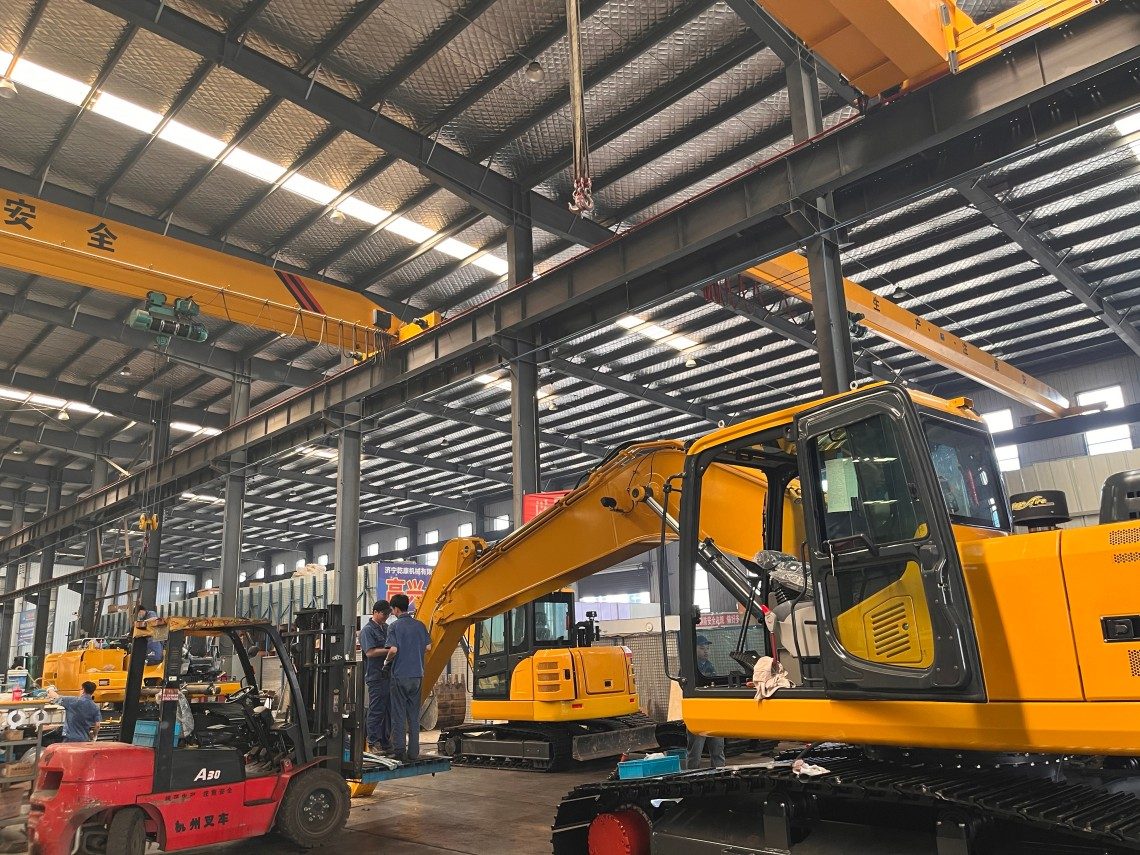
Step-by-Step Assembly Process of Shitian Large Excavator
Step 1 – Undercarriage (Track Frame & Travel Mechanism) Assembly
The undercarriage is the foundation supporting the whole machine. Operators first place the track frame on the assembly platform. Then install track rollers, carrier rollers, idlers and drive wheels in sequence. Each roller’s bearing is coated with lithium-based grease (NLGI 2 grade), and bolts are tightened to the specified torque (650–700 N·m for M24 bolts).
Undercarriage assembly requires high precision: the parallelism of left and right track frames ≤0.5/1000, ensuring stable travel.
Step 2 – Revolving Bearing & Upper Structure Connection
The revolving bearing connects the undercarriage and upper structure, enabling 360° rotation. Operators clean the bearing’s mounting surface and undercarriage top surface to remove oil and burrs. The bearing is hoisted into place with a crane, aligned with positioning pins, and fastened with high-strength bolts using “torque + angle” dual control (50% pre-torque + 120° final tightening).After connection, the upper structure (with engine, hydraulic tank, radiator pre-installed) is hoisted onto the revolving bearing and fixed, forming the main body.
Step 3 – Hydraulic System Installation & Oil Circuit Cleaning
The hydraulic system is the “blood circulation” of the large excavator, controlling all actions. Operators install the main hydraulic pump, control valve, oil cylinders and pipelines. All hydraulic components are cleaned strictly: fuel tanks and valve blocks are washed with kerosene, then polished with anhydrous ethanol and silk cloth, and finally purged with 0.3 MPa dry air to ensure no contamination.After installation, the system is filled with anti-wear hydraulic oil, and a 24-hour pressure test is conducted to check for leaks, ensuring stable pressure under heavy loads.
Power System & Cab Installation
The engine (core power source) is hoisted to the upper structure’s designated position with a crane, fitted with shock absorbers to reduce vibration. Then install the radiator, air filter and fuel tank, connecting air intake, exhaust and fuel pipelines.Next, the cab (equipped with control levers, display, air conditioning) is mounted on the front of the upper structure. Electrical systems (wiring harness, sensors, controller) are connected and debugged to ensure precise control and real-time monitoring.
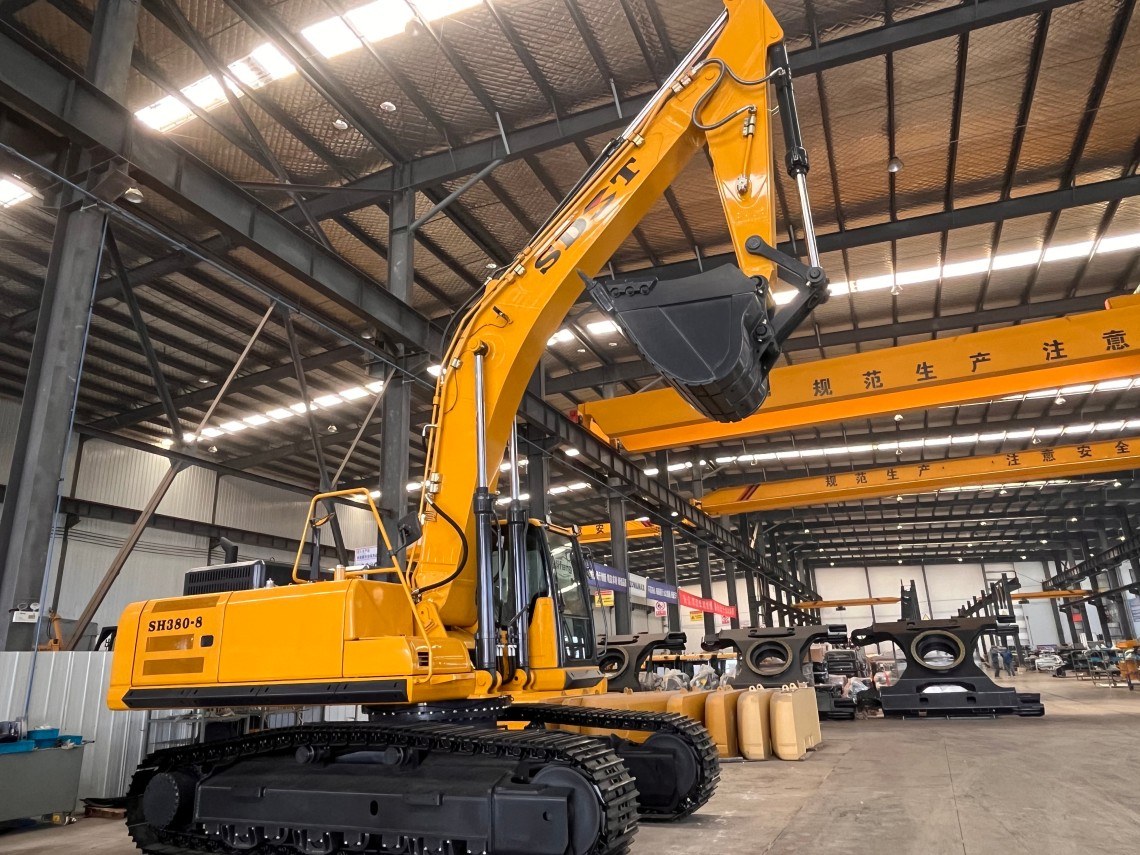
Step 5 – Working Device (Boom, Arm, Bucket) Assembly
The working device directly performs excavation tasks. Operators first connect the boom to the upper structure’s front frame with pins, then install the arm and bucket in sequence. Each pin is coated with high-temperature grease, and locking bolts are tightened to prevent loosening.After assembly, the boom, arm and bucket cylinders are connected to the hydraulic system. Operators test the full range of motion to ensure flexible operation and accurate positioning.
Step 6 – Counterweight Installation & Final Adjustment
Counterweight ensures the excavator’s balance during heavy excavation. Operators hoist the counterweight to the rear of the upper structure with a crane, align it with mounting holes, and tighten high-strength bolts to the specified torque.Finally, adjust track tension (sag 30–50 mm), check all bolt torques, and clean the whole machine to complete assembly.
Core Operating Skills for Shitian Assembly Workers
Shitian’s assembly team consists of skilled technicians with over 5 years of experience, mastering core skills to ensure large excavator quality:
Precision Measurement & Control: Proficient in using torque wrenches, levels and micrometers to strictly control assembly tolerances (e.g., revolving bearing runout ≤0.1 mm).
Hydraulic System Expertise: Skilled in oil circuit cleaning, leak detection and pressure adjustment to avoid hydraulic oil leakage or insufficient pressure.
Familiarity with Modular Assembly: Master standardized processes for each module, ensuring consistent assembly quality for every excavator.
Strict Quality Awareness: Implement “self-inspection, mutual inspection, special inspection” at every stage to eliminate unqualified products.
FAQ
What quality standards do Shitian large excavators meet?
Our excavators comply with ISO 9001, CE certification and Chinese national standards. All core components are sourced from international first-tier suppliers, with strict factory testing before delivery.
What is the production cycle for a large excavator?
The total production cycle is 25–30 days, including 7 days for component preparation, 10 days for fabrication and coating, 5 days for assembly and 3–5 days for testing. We support customized orders with flexible delivery schedules.
For more details about our large excavator models, customized solutions or pricing, contact Shitian’s international sales team today. We are ready to provide you with one-stop heavy machinery solutions and support your business growth.