Mini, Medium and Large Excavators Maintenance & Usage Guide
Learn the differences between mini, medium & large excavators, their usage scenarios, maintenance tips, cost differences and China’s after-sales support for exported models.
As the global infrastructure construction and mining industry thrive, China’s high-performance excavators have emerged as the top choice for international B2B buyers, boasting an annual export volume of over 100,000 units and a presence in more than 100 countries and regions. Classified by tonnage into mini, medium, and large categories, each type of excavator features distinct differences in working capacity, application scenarios, maintenance demands, and production costs. Grasping these differences is vital for international buyers to select the optimal model, cut operational costs, and prolong equipment service life. This article offers a comprehensive maintenance and usage guide for mini, medium, and large excavators, focusing on their core distinctions, applicable fields, maintenance essentials, production cost variances, and after-sales support—empowering international B2B buyers to make informed procurement decisions and maximize the value of China’s exported excavators.
1. Core Differences Between Mini, Medium and Large Excavators
The classification of mini, medium, and large excavators primarily relies on operating weight (tonnage)—a key factor that directly shapes their working capacity, application scenarios, and maintenance needs. China’s exported excavators cover all three categories, with mature technology, reliable quality, and competitive pricing, effectively meeting the diverse demands of global buyers across various industries.
1.1 Classification Standards & Key Parameters
Mini Excavators: With an operating weight of ≤ 6 tons, they mainly include 1-ton, 2-ton, 3-ton, and 5-ton models. China’s exported mini excavators are compact, flexible in operation, and ideal for small-scale construction projects—making them one of the best-selling categories on cross-border e-commerce platforms.
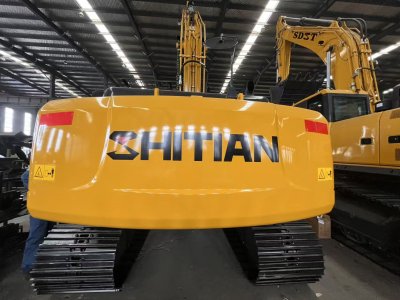
Medium Excavators: With an operating weight between 6-30 tons, the 12-ton, 15-ton, 20-ton, and 25-ton models stand out as the mainstay. Boasting strong versatility, they strike a perfect balance between work efficiency and flexibility, accounting for over 50% of China’s total excavator export volume.
Large Excavators: With an operating weight of ≥ 30 tons, they mainly include 30-ton, 40-ton, 50-ton, and larger models. China’s exported large excavators are equipped with high-power engines and heavy-duty structures, tailored for high-load, high-efficiency operations, and widely applied in large-scale mining and infrastructure projects.
1.2 Differences in Working Capacity
An excavator’s working capacity is closely linked to its tonnage, with significant gaps between mini, medium, and large models—and these gaps directly define their respective application fields:
Mini excavators have a bucket capacity of 0.1-0.3 cubic meters and a maximum digging depth of 2-4 meters. Designed for light-load operations, they feature low fuel consumption (3-8 liters per hour) and flexible mobility, enabling them to adapt seamlessly to narrow working spaces.
Medium excavators offer a bucket capacity of 0.5-1.5 cubic meters, a maximum digging depth of 5-8 meters, and a fuel consumption of 10-25 liters per hour. Equipped with strong digging and loading capabilities, they can efficiently complete most general construction tasks.
Large excavators have a bucket capacity of 2.0 cubic meters or more, a maximum digging depth of 8-15 meters, and a fuel consumption of 30-60 liters per hour. Engineered for heavy-load operations, they deliver exceptional wear resistance and stability, making them capable of handling harsh working environments such as mines and large-scale earthworks.
2. Applicable Scenarios of Mini, Medium and Large Excavators
Each type of excavator is designed for specific working scenarios. Selecting the right model based on project requirements not only boosts work efficiency but also reduces maintenance costs and extends equipment service life. China’s exported excavators are customized to suit different regional scenarios, further enhancing their adaptability in global markets.
2.1 Mini Excavators: Small-Scale and Narrow-Space Operations
Mini excavators are primarily used for small-scale construction and maintenance projects, particularly in narrow spaces where large equipment cannot access. Common application scenarios include: urban residential renovation, garden landscaping, pipeline laying (water supply, gas, electricity), small-scale earthwork, farmland water conservancy, and indoor construction. They are also widely utilized in European and American family farms and urban maintenance projects, becoming a top-selling category in China’s excavator exports.
For instance, China’s 3-ton mini excavators are highly popular in Southeast Asian and European markets, thanks to their compact size and low fuel consumption—allowing them to easily access narrow alleys and residential courtyards to complete maintenance and renovation tasks.
2.2 Medium Excavators: Versatile General Construction
Medium excavators are the most widely used type in the global construction industry, offering strong versatility and adaptability to suit most general construction projects. Common application scenarios include: road construction (excavation and filling), building foundation excavation, urban infrastructure construction, port loading and unloading, and medium-scale mining. As the core force of China’s excavator exports, they account for over half of the total export volume.
China’s 20-ton medium excavators are highly favored by international buyers for their high performance, reliable quality, and cost-effectiveness. They are widely used in infrastructure projects across Africa, the Middle East, and Southeast Asia, earning a strong reputation in the global market.
2.3 Large Excavators: Heavy-Duty and Large-Scale Operations
Large excavators are specifically designed for heavy-duty, large-scale operations that require high load-bearing capacity and long-term stability. Their robust structure and high-power configuration make them indispensable in large-scale engineering projects, and they are also a key growth driver of China’s excavator exports to mining-intensive markets.
Common application scenarios for large excavators include: large-scale open-pit mining (coal, iron ore, copper ore, etc.), large-scale earthwork projects (such as dam construction, airport construction, and highway reconstruction), port bulk cargo loading and unloading, and large-scale urban renewal projects. In regions with booming mining industries such as Australia, Brazil, and South Africa, China’s large excavators have become the preferred choice for local mining enterprises due to their strong durability and high efficiency.
For example, China’s 30-ton and 40-ton large excavators are widely used in iron ore mining projects in Brazil. Their heavy-duty buckets and high-power engines can efficiently complete ore excavation and loading tasks, reducing project cycles and operational costs for buyers. Meanwhile, these models are customized according to the high-temperature and dusty environment in Brazilian mines, further improving their adaptability and service life.
FAQ
1.How to choose between mini, medium and large excavators according to my project?
Choose based on project scale, working space, and load requirements. For small-scale projects (such as residential renovation, landscaping) and narrow spaces, choose mini excavators (1-5 tons); for general construction projects (such as road construction, building foundation), choose medium excavators (12-25 tons); for large-scale mining and heavy earthwork, choose large excavators (30 tons and above). Our professional team can provide personalized suggestions based on your specific project needs.
The service life depends on maintenance and working environment. With scientific maintenance, mini excavators can be used for 8-10 years, medium excavators for 10-15 years, and large excavators for 12-18 years. China’s excavators adopt high-quality components and mature technology, which have longer service life than similar products in the same price range.
3.How to obtain spare parts for China’s exported excavators overseas?
We have established localized spare parts centers in key export markets, and you can directly contact the local service station to purchase spare parts, with a delivery cycle of 3-7 days. In addition, you can also order spare parts through our official website or cross-border e-commerce platform, and we will deliver them through efficient international logistics.